
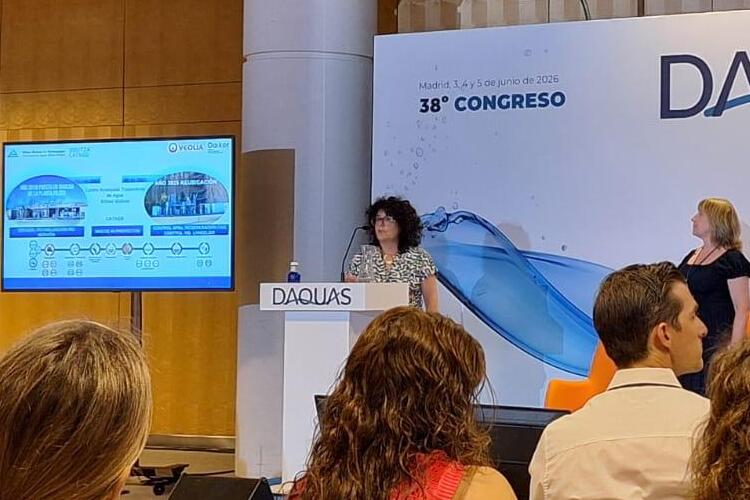
CATABB members have presented two significant scientific contributions at the 38th DAQUAS Congress. The research, developed at CATABB, addresses critical aspects concerning the control of disinfection by-products in water potabilisation.
The first oral presentation, entitled “ Menos es más”: Control de ácidos haloacéticos para un agua de calidad”, was delivered by Patricia Maeso Carcedo and Maite Cabañas Alonso. The study, framed within the HALURA IV project, provides a technical analysis of the minimisation of haloacetic acids generated throughout the various treatment stages. Through pilot-scale investigation, diverse process configurations were evaluated utilising water sourced from the Zadorra reservoir and the Nervión river, monitoring not only haloacetic acids but also trihalomethanes, bromates, chlorites and chlorates.
The second contribution, included in the Congress proceedings, was the presentation of “El cloro: desafíos invisibles en la ruta del agua” by Ana Urkiaga. This research examines the challenges presented by chlorine in water potabilisation, from supply through to the point of consumption. Results from projects conducted at CATABB demonstrate the effect of sodium hypochlorite storage conditions on its degradation and the formation of chlorites and chlorates, highlighting the influence of solar radiation and temperature.