

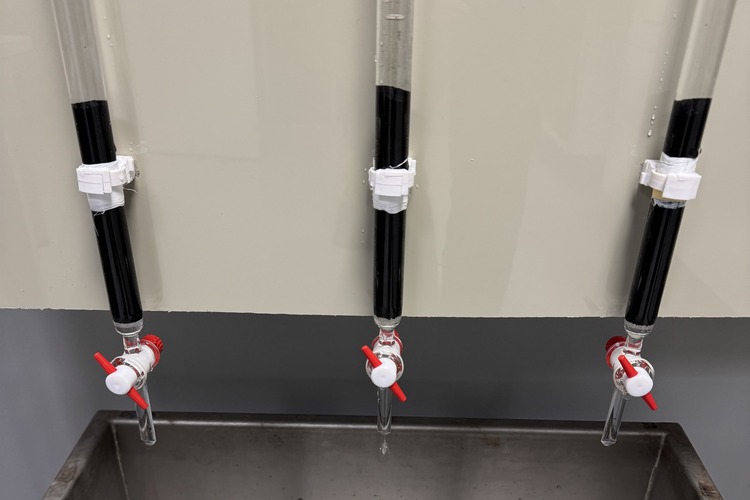
The study of adsorption and desorption processes in activated carbon filters is essential for understanding and optimising the removal of contaminants in drinking water treatment. However, some contaminants are present at such low concentrations in the effluent that their analysis becomes challenging, and the use of plant-scale doping would be economically unfeasible. To overcome these limitations, the use of rapid small-scale column tests (RSSCT) is proposed. This approach enables the acquisition of representative results for adsorption and desorption processes at a smaller scale and lower cost, simulating the conditions of activated carbon filters in water treatment plants (WTP) in a manageable and economically viable manner.
The AGOCABB II project is a continuation of the AGOCABB I project, previously developed at the CATABB facilities. In this new phase, the rapid column system will be installed at the Venta Alta WTP, where the exhaustion process of activated carbon will be studied by analysing various parameters, including trihalomethanes (THM), total organic carbon (TOC), and UV absorbance, among others. The main objectives of the project include improving the design of the RSSCT columns used in the Etxebarri Pilot Plant to optimise washing and backwashing processes in accordance with ASTM D6586-03, evaluating the effect of different operational configurations over longer timeframes, and developing more efficient configurations according to the type of water to be treated.